
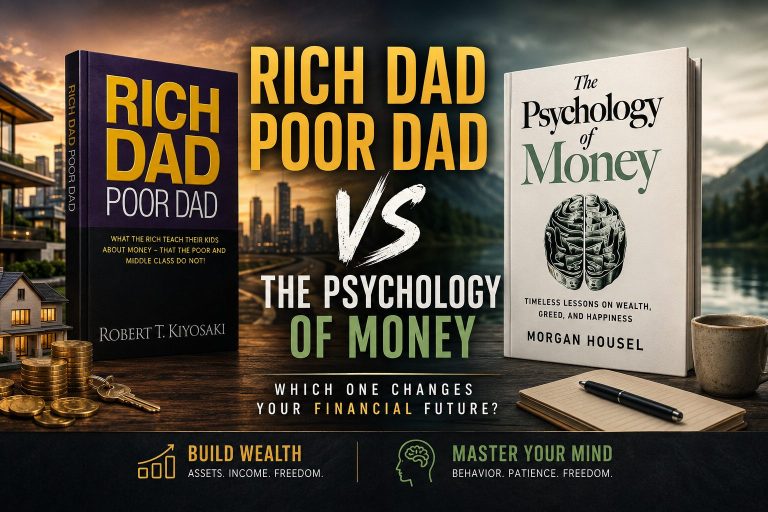
Rich Dad Poor Dad vs The Psychology of Money

Two Books. Two Different Roads to Wealth.
If you asked 100 financially successful people to recommend one money book, two titles would appear again and again:
- Rich Dad Poor Dad by Robert Kiyosaki
- The Psychology of Money by Morgan Housel
Both books changed millions of lives.
Both became global bestsellers.
Both challenge traditional thinking about money.
But here’s what most people miss:
These books are not competitors.
They are teaching completely different parts of the wealth equation.
Reading only Rich Dad Poor Dad is like learning how to build a race car without learning how to drive.
Reading only The Psychology of Money is like learning how to drive perfectly without owning a car.
The magic happens when you understand both.
Let’s break down why.


6
The Fundamental Difference
The easiest way to understand these books is this:
Rich Dad Poor Dad teaches:
How wealth is created.
The Psychology of Money teaches:
How wealth is preserved.
That difference sounds small.
It isn’t.
In reality, it may be the most important distinction in personal finance.
Many people know how to make money.
Very few know how to keep it.
Rich Dad Poor Dad Is About Building Assets
When Robert Kiyosaki wrote Rich Dad Poor Dad, he challenged one of society’s deepest assumptions:
Work hard and you’ll become wealthy.
His argument was shocking:
Working harder does not automatically create wealth.
Ownership does.
The book repeatedly pushes readers toward one central idea:
Assets create freedom.
Income pays bills.
Assets create independence.
That’s why Kiyosaki became obsessed with:
- businesses
- investments
- real estate
- cash-flow assets
The entire book revolves around a simple question:
Does this put money into my pocket or take money out?
That question alone can change financial decisions forever.


5

Tool: See Real Income-Producing Assets
Instead of only reading about assets, look at real ones:
Acquire is a marketplace where entrepreneurs buy and sell online businesses generating real cash flow.
Why this matters:
Most people imagine assets.
Acquire lets you see them.
You can literally browse websites producing:
- $1,000/month
- $10,000/month
- $50,000/month
It transforms the concept of “assets” from theory into reality.
The Psychology of Money Is About Human Behavior
Morgan Housel starts from a completely different place.
He argues that:
Most financial mistakes are not caused by ignorance.
They are caused by behavior.
People know they should:
- save money
- invest consistently
- avoid emotional decisions
- think long term
Yet many don’t.
Why?
Because humans are emotional.
Fear.
Greed.
Envy.
Ego.
Impatience.
These forces influence financial outcomes more than spreadsheets ever will.
And that’s where Housel’s work becomes incredibly powerful.
He explains that:
Wealth is often less about intelligence and more about behavior.


4
Tool: Discover Why Investors Underperform
This resource explains a brutal truth:
Many investors don’t lose because markets fail.
They lose because emotions take control.
It perfectly demonstrates Morgan Housel’s argument that:
Behavior often matters more than strategy.
The Most Dangerous Financial Myth
Both books attack a common belief:
Income equals wealth.
It doesn’t.
Imagine two people:
Person A earns $250,000/year.
Person B earns $90,000/year.
Most people assume Person A wins.
But what if:
- Person A spends everything.
- Person B invests consistently for 20 years.
The outcome could be completely different.
This is one of the most important ideas in personal finance.
Money isn’t about what you earn.
It’s about what you keep.
Tool: Watch Compounding Work
Try this experiment:
- $300/month
- 10% return
- 30 years
The results surprise almost everyone.
Why?
Because compounding feels slow…
Until it becomes enormous.
Why Most People Never Become Wealthy
Here’s an uncomfortable truth:
Most people don’t fail financially because they lack information.
They fail because they:
- spend emotionally
- compare themselves to others
- chase status
- underestimate time
- overestimate short-term results
This is where both books intersect.
Rich Dad Poor Dad solves:
What should I do?
The Psychology of Money solves:
Why don’t people do it?


8
The Hidden Lesson Both Books Share
After reading both books, a pattern emerges.
Rich Dad Poor Dad says:
Build assets.
The Psychology of Money says:
Survive long enough for those assets to compound.
That may be the single most valuable lesson from both books combined.
One teaches acceleration.
The other teaches endurance.
Wealth requires both.
Final Verdict
If your goal is:
Learning how wealth is built
Start with:
Rich Dad Poor Dad
If your goal is:
Understanding why people succeed or fail financially
Start with:
The Psychology of Money
But the best answer is:
Read both.
Because one changes your strategy.
The other changes your behavior.
And wealth requires both.


8
🎧 Want the Full Audio Summaries?
This article only explored a fraction of the ideas inside Rich Dad Poor Dad and The Psychology of Money.
Inside Mentixo, you’ll find:
✔ 10-minute audio summaries
✔ powerful ideas from bestselling books
✔ practical lessons about money, business, investing and psychology
✔ actionable concepts you can apply immediately
🚀 Try Mentixo FREE for 30 days.
Because the right idea, learned at the right time, can change the direction of your entire financial future.
👇 Explore the full audio library: